From Project Jupyter

Open infrastructure
for health care.

Open software. Shared standards. Private data.

A secure, connective layer for integrating wearable, clinical, and patient-generated data into modern computational and AI-enabled health care workflows.

Customizable · Modular · FHIR-native · AI-ready · Open License

Built on decades of open infrastructure

01 - Platform

Four pillars. One platform.

A unified architecture combining data ingestion, scalable computation, analytical tools, and community governance.

Data Integrity

Privacy-first data management adhering to HL7 FHIR and IEEE/Open mHealth standards. Secure, compliant, and ready for any health data workload.

Run it Anywhere

Containerized and Kubernetes-native. Run it in the public cloud, private cloud, or on-prem behind your firewall.

Versatile Tooling

Analytics and visualization built on Jupyter. APIs and standards-based data layers ready for decision support, AI tools, and patient-facing applications to build on.

Open by Design

Health infrastructure should outlast its vendors. Every layer is open standards and open code. The data stays private, you control the infrastructure.

02 - Use Cases

From research to care.

JupyterHealth is the connective infrastructure for working with health data, from biomarker discovery and real-world evidence through clinical and patient-facing care. Built on open standards and modern scientific computing, it supports use cases within and beyond the clinic.

Research & Pharma

Biomarker Discovery

Integrate wearable, clinical, and patient-generated data for digital biomarker discovery, longitudinal analysis, and translational research.

MedTech & Devices

Real-World Validation

Run pilots, collect real-world evidence, and evaluate device performance across clinical and at-home settings.

Direct-to-Patient

Edge Medicine

Most chronic conditions are managed between clinical visits. Support continuous monitoring and patient-facing care beyond the clinic.

03 - Integration

Plug in on your terms.

Adopt the full platform or integrate individual components into your existing stack. Deploy, customize, and extend the infrastructure to fit your needs.

  • Deploy in the cloud or on-premise
  • Native support for HL7 FHIR and Open mHealth (IEEE 1752)
  • Open-source under the BSD-3 license
View deployment documentation
Discovery
Decision support
Remote Care
JupyterHealth Platform
Hub
JupyterAINotebooksDashboardsAPIs
Exchange
Ingestion · Standardization · Storage
Data Sources
EHRs · devices · wearables · sensors · surveys

04 - About the team

Built by experts. Built to last.

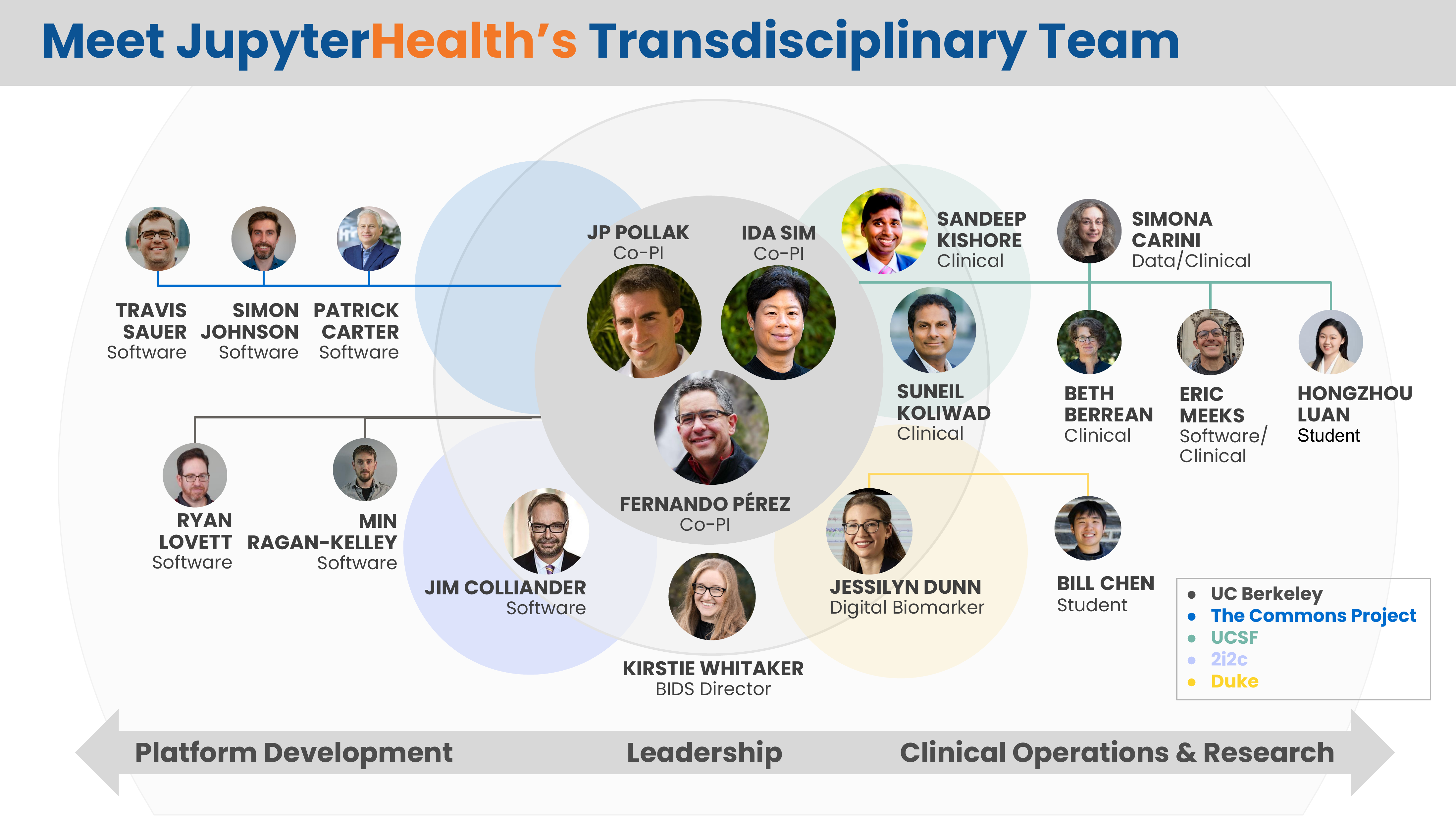
JupyterHealth is built and maintained by the teams behind the world's most widely adopted open-source data science tools. A long-term, sustainably funded initiative providing stable infrastructure that health care can rely on.

JupyterHealth team org chart, grouped by Platform Development, Leadership, and Clinical Operations & Research bands across UC Berkeley, The Commons Project, UCSF, 2i2c, and Duke.

Founded at

Talk to the team.

Get in touch about pilots, integrations, or deployments.

jupyterhealth@berkeley.edu